

Pricing Your First Version
Price against what the customer currently spends on the problem, not against your costs or your competitors. Their current spend includes the hours, the workaround and the consequences of not solving it. First versions are usually priced too low, which attracts the wrong customers, makes support unaffordable, and leaves you competing on a dimension you cannot win.
The reflex to price low, and what it costs
Nearly everyone prices their first version too low, and the reasoning is always the same: it is not finished yet, so it should be cheap.
That sounds like modesty and behaves like a trap.
Low prices attract the customers most likely to churn and most likely to need support, because a low price signals low stakes and attracts people who are browsing rather than solving. High-volume, low-price businesses need scale to work, and you do not have scale.
Low prices also make it impossible to serve people properly. At twenty a month you cannot afford to spend an hour helping someone. At four hundred a month you can, and helping them is what turns the first ten customers into references.
And they are hard to reverse. Raising a price on existing customers is uncomfortable, so the early number tends to become permanent long after it has stopped making sense.
Price against their current spend
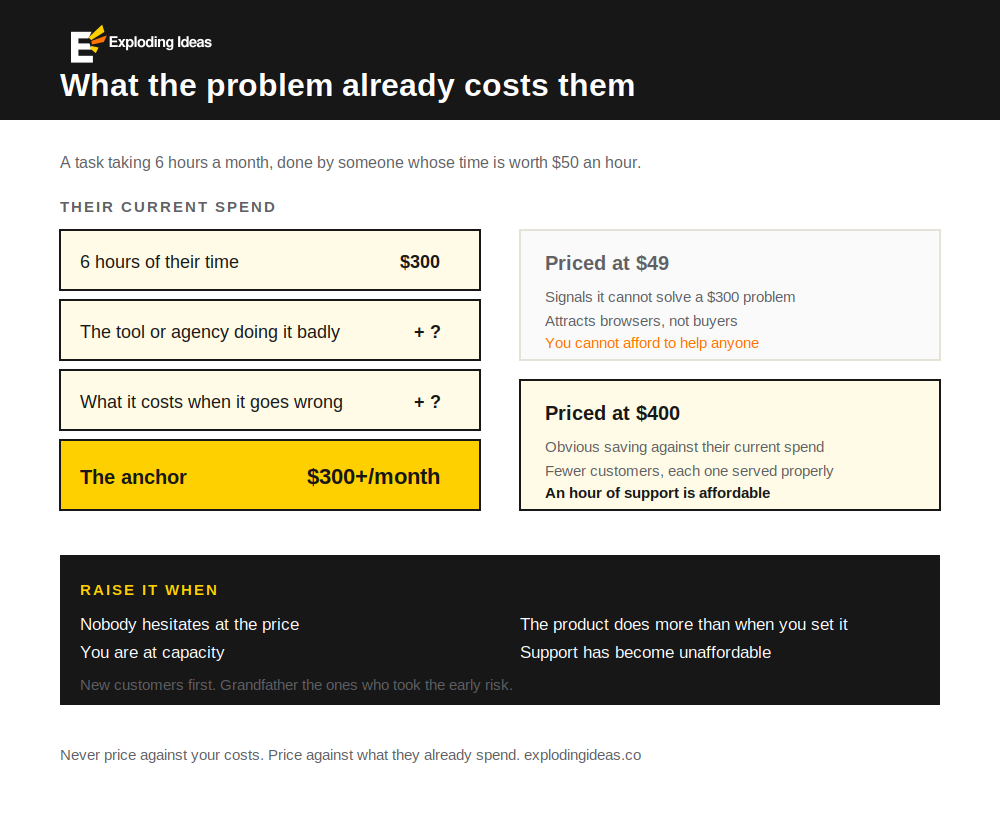
The only pricing anchor that matters early is what the problem costs the customer today.
That is not what they pay a competitor. Most of the time there is no competitor, and the alternative is a person, a spreadsheet, an agency or living with the consequences.
Work it out concretely. How many hours a month does someone spend on this, and what is that time worth. What do they pay someone else to do it badly. What does the problem cost when it goes wrong: a lost customer, a fine, a delayed project.
If a task takes six hours a month and the person doing it costs fifty an hour, the problem costs three hundred a month. A price of forty-nine is not a bargain, it is a signal that your product cannot possibly solve a three-hundred problem.
Choosing the number
Business customers. Price on value and keep it simple. One price for one outcome. Complexity in a pricing page is a reason to delay a decision, and delay is your enemy at this stage.
Consumers. Price against habit and comparison, because consumers do benchmark. But the same rule applies: the cheapest tier attracts the heaviest support load.
Services. Never hourly at the start. Hourly caps your income at your speed and punishes you for getting better. Fixed scope at a fixed price, and raise it when you are booked.
Test with the first ten, not with a survey. What people will pay is only observable when they are asked to pay.
What to do instead of discounting
Discounting a new product teaches customers that the price is negotiable and that waiting is rewarded.
If you need to lower the barrier, change what is included rather than what it costs. A shorter engagement, a narrower scope, a smaller plan, a paid pilot with a defined end. All of those preserve the price and reduce the risk, which is what the customer is actually worried about.
If someone genuinely cannot afford it, they are probably not your customer at this stage. That is a legitimate thing to accept.
When to raise it
Sooner than feels comfortable. The signals:
Nobody hesitates. If no one flinches at the price, it is too low. You are booked or capacity constrained. Price is the only lever that fixes this without hiring. The product does more than when you set the number, which happens quietly and constantly. Your support burden is unaffordable at the current price, which is a pricing problem wearing an operations costume.
Raise it for new customers first. Existing customers can be grandfathered, and often should be, because they took a risk on an unfinished product and that is worth something.
Free: the Fit Checklist
A short checklist for deciding whether an idea fits you before you spend anything on it. It arrives by email and subscribes you to the free Sunday edition.
FAQ
How do you price a product with no competitors? Against what the customer spends on the problem today: the hours, the workaround, the person doing it manually, and the cost of it going wrong. Absence of competitors means no comparison, not no value.
Should a first version be cheap because it is incomplete? No. Incomplete affects what you promise, not what it is worth. Low prices attract customers who churn, generate support you cannot afford, and are hard to raise later.
Is it better to charge hourly or a fixed price for services? Fixed, at the start. Hourly caps your income at your speed and penalises you for becoming faster, and it makes every conversation a negotiation about time rather than outcome.
Should I offer a free tier? Rarely, this early. Free tiers generate support load without revenue and delay the thing you need most, which is evidence that people will pay.
When should I raise prices? When nobody hesitates, when you are at capacity, when the product does more than when you set the price, or when support has become unaffordable. Raise for new customers and consider grandfathering the first ones.
What if customers say it is too expensive? Some should. If nobody does, the price is too low. What matters is whether the people who fit your customer description buy, not whether everyone finds it affordable.
Free: the Fit Checklist
A short checklist for deciding whether an idea fits you before you spend anything on it. It arrives by email and subscribes you to the free Sunday edition.