
What Separates an Idea Born From Real Change
An idea born from real change has an answer to why now: a regulation, a technology, a demographic shift or a behaviour that moved recently and created customers who did not exist before. An idea born from imitation has no such answer, only the observation that someone else appears to be doing well. The first has a window. The second has competitors who started earlier.
Two ideas that look identical
Two people decide to start a business helping small firms with compliance.
The first noticed that a specific regulation took effect this year, that it applies to companies under a size threshold that no consultancy bothers with, and that the firms affected have been posting confused questions in trade forums since spring. There is a deadline, a defined group, and a problem with a date attached.
The second read that compliance consulting is a growing market.
On a list, these look like the same idea. In practice one of them has customers with a deadline and no supplier, and the other is entering a mature market against established firms with references.
The difference is not effort or execution. It is that one idea came from a change and the other came from a category.
The five signals
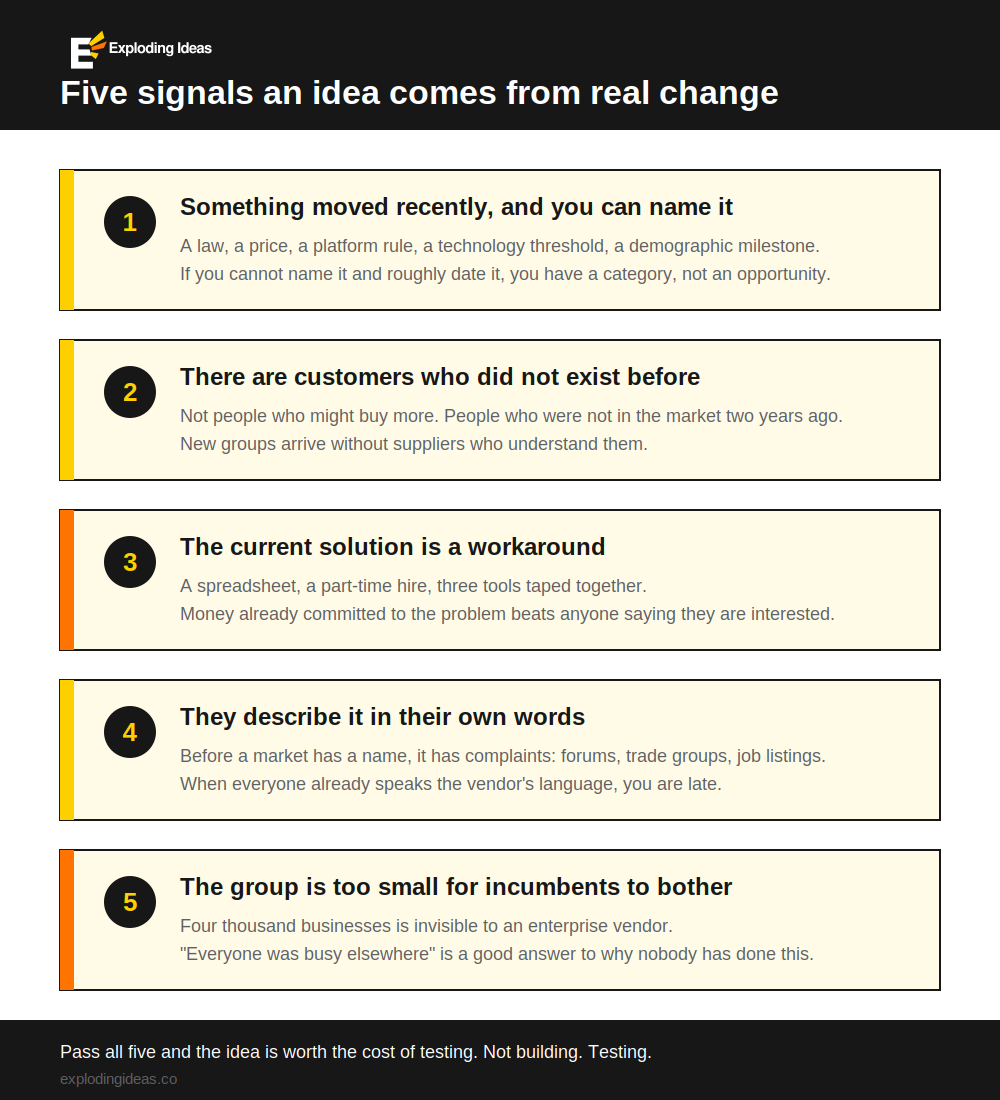
1. Something moved recently, and you can name it
A law, a price, a platform rule, a technology threshold, a demographic milestone. If you cannot name the change and roughly when it happened, you are looking at a category, not an opportunity.
The test is specificity. “AI is changing everything” is not a change you can build on. “The cost of transcription fell to near zero in 2023, which made per-minute pricing on transcription services obsolete” is.
2. There are customers who did not exist before
Not customers who existed and might now buy more. Customers who were not in the market at all two years ago.
Remote workers who travel unpredictably. Landlords facing a new energy standard. Clinics required to keep a record they were not required to keep. When a group appears, it appears without suppliers who understand it, which is the whole opportunity.
3. The current solution is a workaround
The best evidence a market exists is people already paying, badly. A spreadsheet held together by one person. A part-time hire doing something that should be automated. Three tools taped together.
Workarounds are money that has already been committed to the problem. They are far better evidence than anyone saying they would be interested.
4. The people affected are talking about it in their own words
Before a market has a name, it has complaints. Forums, trade groups, comment sections, job listings. When you can read people describing the problem without using your product category’s vocabulary, the problem is real and unsolved.
When everyone is already using the vendor’s language, you are late.
5. Nobody has bothered because the group is too small for incumbents
This is the most reliable signal of all, and the least exciting. Large companies ignore markets that cannot move their revenue. A group of four thousand businesses is invisible to an enterprise vendor and life-changing for one person.
If your answer to why nobody has done this is that everyone was busy elsewhere, that is a good answer.
The signals that mislead
Someone else is doing well. Says nothing about whether you can. They may have started earlier, have distribution you lack, or be losing money.
The market is large and growing. Large markets have large competitors. Growth in a mature category mostly accrues to whoever already has customers.
Everyone says they would use it. Interest is free. Commitment is not. The only reliable version of this signal is somebody paying before it exists.
It is a good idea. Ideas are not good or bad in the abstract. They are early, late or wrong for you.
What to do with an idea that passes
Passing these five signals does not mean the idea works. It means it is worth the cost of testing, which is the only decision you are making at this stage.
The next step is not building. It is finding five of the customers you identified and asking what they do today, what it costs them, and what would have to be true for them to change. That conversation ends most ideas cheaply, which is the point.
Free: the Fit Checklist
A short checklist for deciding whether an idea fits you before you spend anything on it. It arrives by email and subscribes you to the free Sunday edition.
FAQ
How do you know if a business idea has good timing? Name the change that made it possible and roughly when it happened. If you cannot, the timing is probably neutral, which means you are competing on execution against people who started earlier.
What is the strongest evidence that a market exists? People already paying for a workaround. A spreadsheet, a part-time hire, three tools taped together. That is money already committed to the problem.
Is it bad if competitors already exist? No, competitors prove demand. It is bad if they are established, well distributed and serving the same customer you were planning to serve with the same thing.
Why do small markets matter? Because large companies ignore them. A group too small to move an incumbent’s revenue can comfortably support one person, and that gap is where most workable ideas live.
What should I do before building? Talk to five of the specific customers you identified. Ask what they do today and what it costs. Most ideas end there, cheaply, which is a good outcome.
Free: the Fit Checklist
A short checklist for deciding whether an idea fits you before you spend anything on it. It arrives by email and subscribes you to the free Sunday edition.