Founder-Led Sales Without a Sales Background
Early sales conversations are research that occasionally ends in a purchase. The founder is the best person to run them, not despite lacking sales training but because of it: the goal is to understand what the customer does today and decide whether you can help, and being unable to perform a sales pitch removes the main obstacle to that.
You are not bad at this, you are doing a different job
Most people who have never sold assume selling means persuading, and dread it accordingly.
At this stage it is not persuasion. Nobody is going to be talked into buying an unfinished product from a business they have not heard of, and attempting it wastes the conversation. What actually happens in a good early sales call is that you find out how the person handles the problem today, what it costs them, what they have already tried, and what would have to be true for them to change.
At the end you decide whether you can help. Sometimes you can, and you say so, and they buy. Often you cannot, and saying that plainly is what earns the referral six months later.
That is a job founders are good at, because you know the problem better than anyone you could hire.
The structure of the conversation
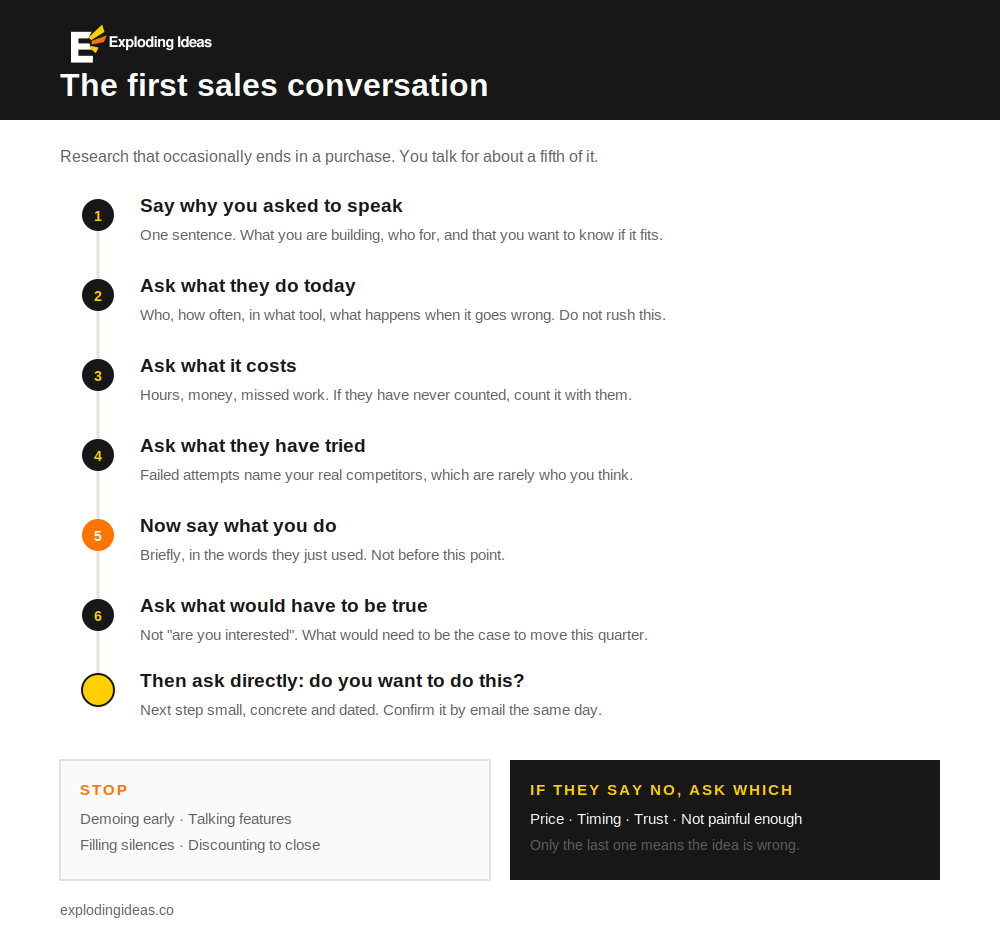
Open by explaining why you asked to speak. One sentence. What you are building, who it is for, and that you are trying to understand whether it fits.
Ask what they do today. In detail. Who does it, how often, in what tool, what happens when it goes wrong. This is the whole conversation and most people rush it.
Ask what it costs. Hours, money, missed work, the person they had to hire. If they have never counted, help them count, and let them react to the number.
Ask what they have tried. Failed attempts tell you what your product must avoid and who your real competitors are, which is usually not who you think.
Then, and only then, say what you do. Briefly, and framed in the words they just used.
Ask what would have to be true. Not whether they are interested. What would need to be the case for them to move on this, this quarter.
What to stop doing
Demoing early. A demo answers a question they have not asked yet, and it turns a conversation into a presentation.
Talking about features. They do not care what it does. They care what changes for them.
Filling silences. The most useful sentences in the conversation come after a pause you did not fill.
Discounting to close. Price objections at this stage are usually value objections wearing a disguise, and discounting confirms their doubt.
Chasing everyone. Some people are not your customer. Establishing that quickly is a success, not a failure.
Closing without pressure
Closing early sales is mostly making the next step small, concrete and dated.
Not “let me know what you think”, which guarantees nothing happens. Instead: a paid pilot with a start date, a deposit to reserve capacity, a first delivery next week, a decision by Friday.
Ask directly and plainly. “Do you want to do this?” is a complete sentence and it does more work than any technique. If the answer is not yes, ask what is missing, and believe the answer.
And write down what you promised, in an email, the same day. Half of early sales are lost to ambiguity rather than rejection.
What to do with a no
A no is data, and at this stage it is nearly as useful as a yes.
Ask why, and ask specifically: was it the price, the timing, the trust, or the fact that the problem is not painful enough. Those four have completely different implications, and only one of them means the idea is wrong.
Keep a note of every no with its reason. Twenty of those will show you a pattern that no amount of thinking would have produced, and that pattern is usually the thing you change next.
Free: the Fit Checklist
A short checklist for deciding whether an idea fits you before you spend anything on it. It arrives by email and subscribes you to the free Sunday edition.
FAQ
How do you sell if you have never sold anything? Treat the conversation as research. Ask what they do today, what it costs, what they have tried, and what would need to be true for them to change. Founders do this better than trained salespeople because they understand the problem.
What should you say first? Why you asked to speak: what you are building, who it is for, and that you want to know whether it fits. Then stop talking and ask questions.
When should you demo the product? After you understand their situation, not before. A demo early answers a question they have not asked and turns a conversation into a presentation.
How do you close a first sale? Make the next step small, concrete and dated: a paid pilot starting Monday, a deposit, a first delivery next week. Then ask directly whether they want to do it.
What if they say the price is too high? Usually that means the value is not clear, not that the number is wrong. Ask what they compared it to. Discounting confirms the doubt rather than removing it.
Is a no useful? Yes. Ask whether it was price, timing, trust or insufficient pain. Only one of those four means the idea is wrong, and twenty recorded noes show a pattern you cannot reason your way to.
Free: the Fit Checklist
A short checklist for deciding whether an idea fits you before you spend anything on it. It arrives by email and subscribes you to the free Sunday edition.