
How to Tell a Trend From an Economy
A trend is a rising line: one product, one moment, and an audience that moves on. An economy is a rising line that created a person with an ongoing need, which means recurring spend, supporting services and room for many businesses at once. The test is not how fast the line rises. It is whether the new demand has to be served repeatedly, by more than one kind of supplier.
Both look the same on the graph
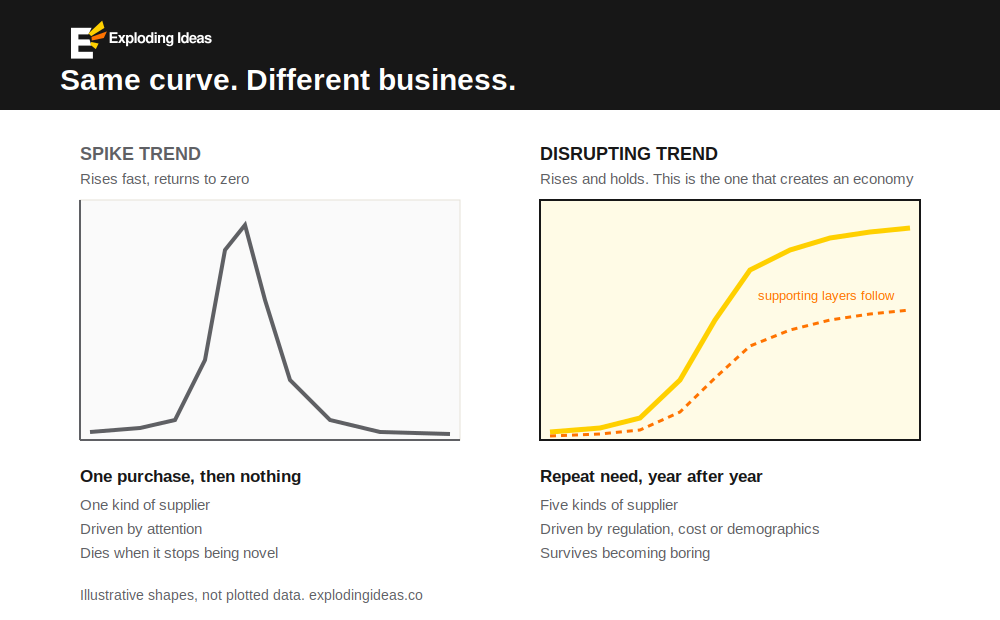
Fidget spinners and home electric vehicle charging both produced steep curves. One made a handful of sellers money for a few months. The other created installers, comparison sites, tariff advisers, software, maintenance contracts and insurance products that will exist in ten years.
If you had only the graph, you could not tell them apart. Search interest rose sharply in both cases, coverage followed, and both looked urgent.
The difference is not visible in the curve, it is visible in what the curve implies about the person underneath it. Somebody who buys a fidget spinner has completed the transaction. Somebody who buys an electric car has acquired a set of ongoing problems: where to charge, what tariff, what happens when it fails, what it does to their insurance, what happens when they sell it.
The first is a purchase. The second is a life change, and life changes create economies.
The four tests
1. Does the demand repeat?
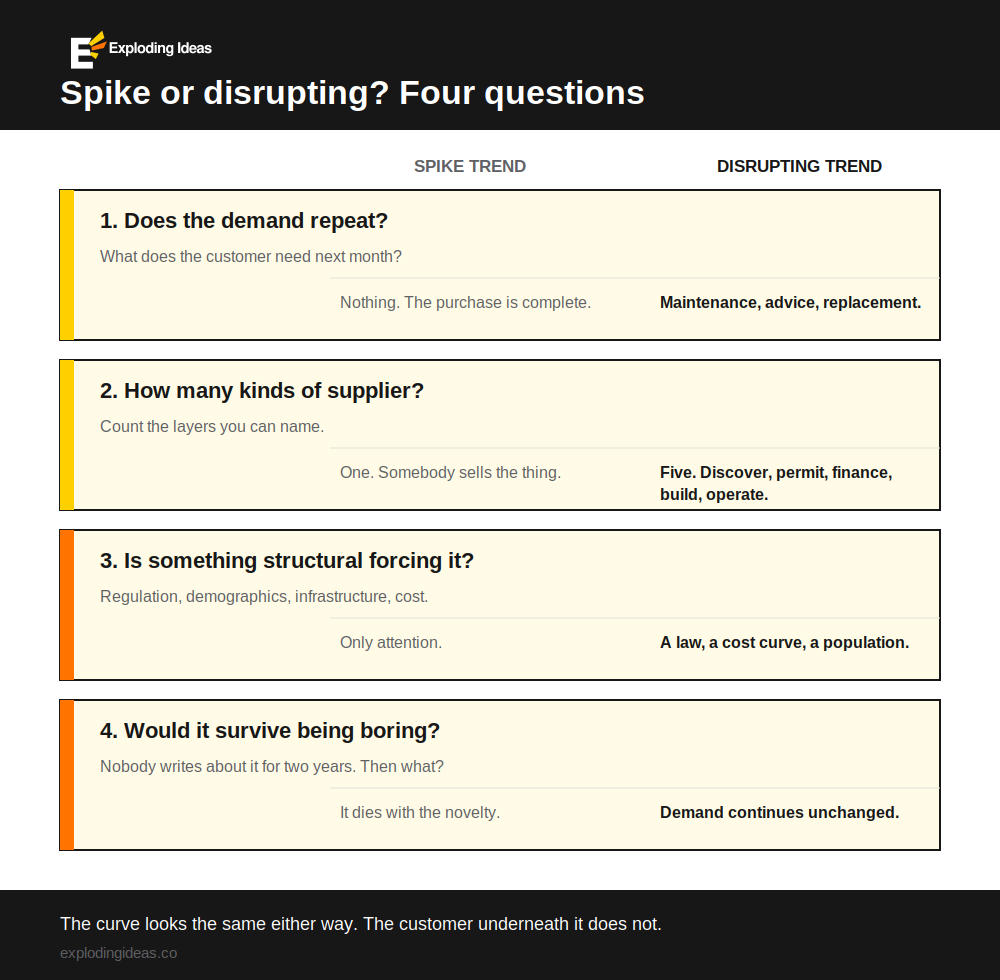
Ask what the customer needs next month. If the honest answer is nothing, you are looking at a trend, and your business ends when the curve does.
Repeating demand does not have to mean subscriptions. It means the need recurs: maintenance, replacement, compliance, seasonal renewal, ongoing advice. Anything where the customer has to come back.
2. Does it need more than one kind of supplier?
A real economy has layers. Somebody helps people discover the thing. Somebody handles the paperwork. Somebody finances it. Somebody builds or installs it. Somebody operates or maintains it afterwards.
Count the layers. If you can only name one, the market is a product category, not an economy. If you can name five, there is room for many businesses that do not compete with each other, which is what makes a niche survivable for a small operator.
3. Is anything structural forcing it?
Fashion reverses. Structure does not, or at least not quickly.
Regulation, demographics, infrastructure and cost curves are structural. If a law obliges the behaviour, if the population that needs it is growing regardless of sentiment, if physical infrastructure has been built, or if a price fell permanently, the demand has a floor under it.
There are three kinds worth separating, because each leaves different evidence. Behavioural, when people become willing to do something they previously would not: visible in surveys, in usage data and in what has stopped being remarked upon. Technological, when a capability arrives or a cost falls permanently: visible in prices, in specifications and in what a single person can now do alone. Regulatory, when a rule obliges, subsidises or forbids: the easiest of the three to verify, because it has a document and a date.
Regulatory is the one most people skip and the one with the clearest edges. A compliance date is a deadline in somebody’s calendar, which is as close to guaranteed demand as this work gets.
If the only thing driving it is attention, the floor is wherever attention goes next.
4. Would it survive the topic becoming boring?
The strongest signal, and the simplest. Imagine nobody writes about this for two years. Does the demand continue?
Solar installation survives being boring. Electric car charging survives being boring. Most viral products do not survive their own novelty, which is precisely what made them sell.
Where in the curve you are matters more than being right
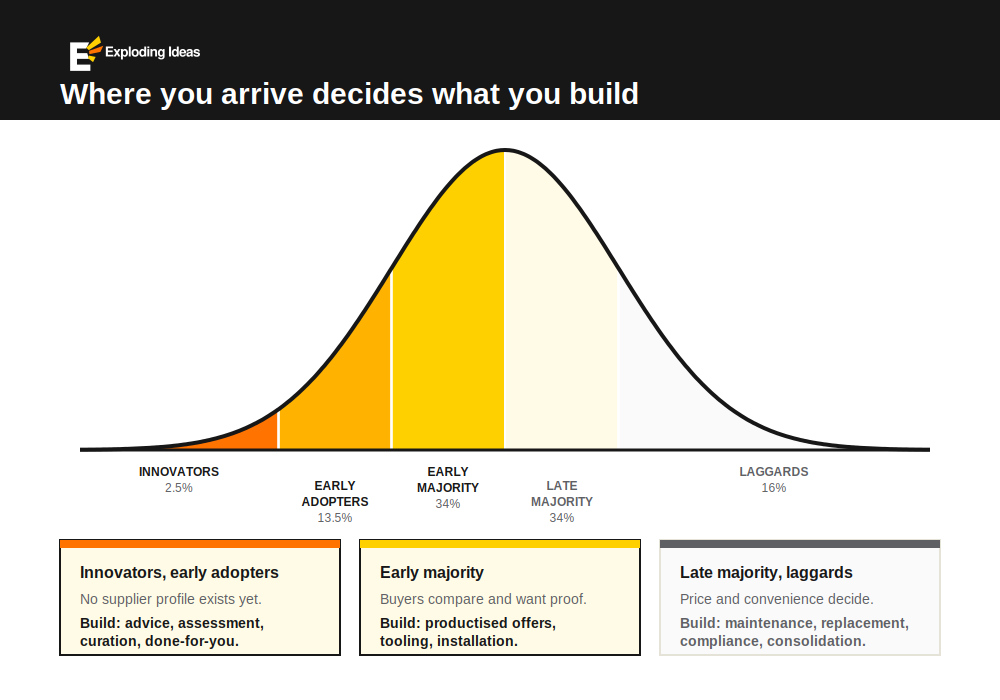
You can identify a genuine economy and still be badly placed, because the economics of entering change dramatically depending on timing.
Too early. The customers exist but do not know they have the problem yet, so you spend your money educating a market that competitors will harvest. Being early is indistinguishable from being wrong for a long time.
The window. Enough customers to sell to, not enough suppliers to compete with. Prices are set by scarcity rather than by comparison, and there is no established vendor to be measured against.
Late. Customers are plentiful, suppliers are plentiful, comparison sites exist, and you compete on price. This is not fatal, but it is a different business requiring different advantages.
The window is short, and it closes faster than it used to. The practical implication is that spotting the economy is only half the work: you also have to be honest about which of these three you are in.
Working through an example
Take the shift to hybrid and unpredictable travel among knowledge workers.
Does the demand repeat? Yes. Every trip creates the same needs again: pets, plants, deliveries, home security, childcare gaps.
Does it need multiple suppliers? Yes: booking and coordination, in-person services, insurance for irregular occupancy, software to manage the schedule.
Is anything structural forcing it? Yes: employer policy changes that have persisted for years, not a mood.
Would it survive being boring? Yes. Nobody writes about hybrid work with excitement any more, and the needs remain.
That is an economy. Whether there is a business in it for you is a separate question, and the answer depends on which layer you can serve better than the people already there.
Free: the Fit Checklist
A short checklist for deciding whether an idea fits you before you spend anything on it. It arrives by email and subscribes you to the free Sunday edition.
FAQ
What is the difference between a trend and an economy? A trend produces one purchase and ends. An economy produces a customer with ongoing needs, which supports repeat spending and multiple types of supplier at once.
How do you know if a trend will last? Ask whether something structural is forcing it, regulation, demographics, infrastructure or a permanent cost change, and whether the demand survives the topic becoming boring. Attention-driven demand ends when attention moves.
Is it better to be early or late to a market? Neither extreme. Too early means paying to educate customers who will buy from someone else later. Too late means competing on price. The window is when customers exist and suppliers do not.
How many layers should an economy have? Enough that you can name several distinct supplier types: discovery, paperwork, finance, build, operate. One layer is a product category. Five is an economy with room for businesses that do not compete.
Can a small operator compete in a new economy? Usually better than in an old one, because incumbents ignore groups too small to move their revenue, and the layers around the obvious product are almost always unserved.
Free: the Fit Checklist
A short checklist for deciding whether an idea fits you before you spend anything on it. It arrives by email and subscribes you to the free Sunday edition.