The $1,000 Experiment: Build, Change or Kill
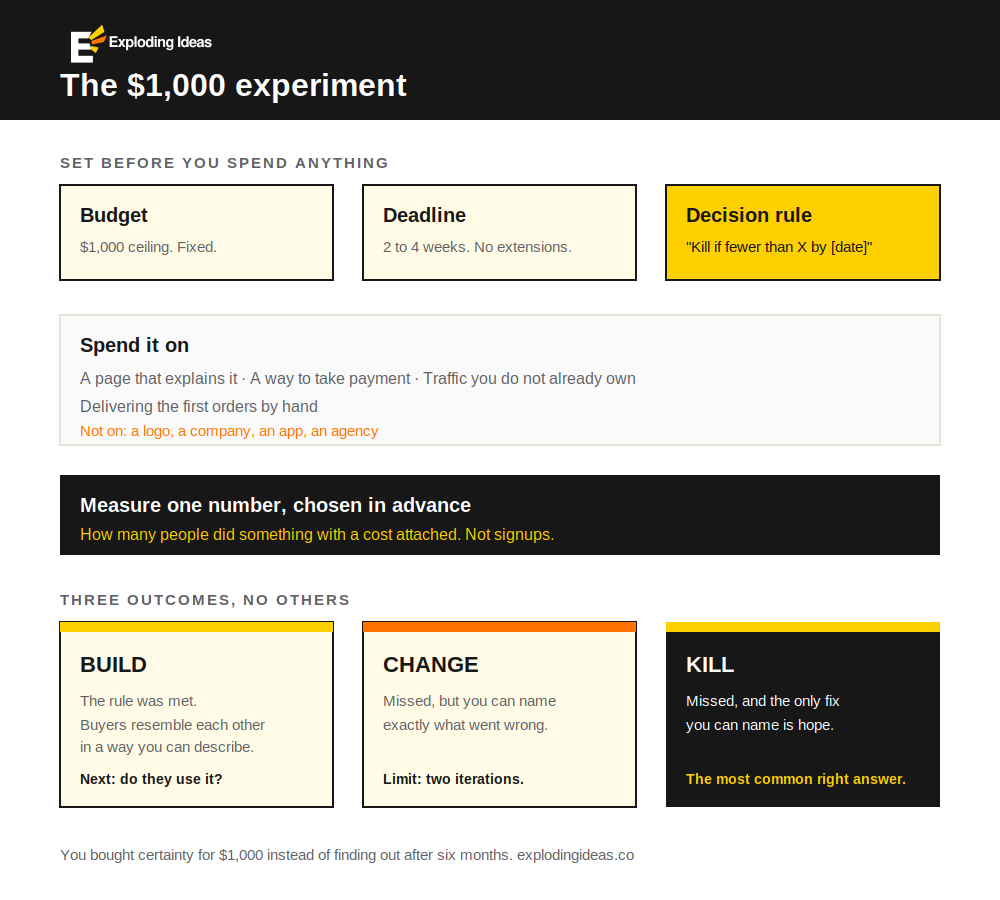
A validation experiment needs three constraints: a fixed budget, a fixed deadline, and a decision rule written before you start. Without the third, every result gets interpreted as encouraging. The rule is that an experiment ends in build, change or kill, and killing is the most common correct answer.
Why experiments without a decision rule are useless
The problem with testing an idea is that you already want it to work.
That is not a character flaw, it is the reason you are testing it at all. But it means ambiguous results will get read generously. Twelve signups from a hundred visitors looks encouraging if you want it to be, and looks fatal if you do not, and both readings are available from the same number.
The fix is boring and effective: decide what result would make you stop, before you can see any results. Write it down. “If fewer than X people do Y by [date], I kill it.”
That sentence is the experiment. Everything else is logistics.
The three constraints
A budget. A thousand is a useful ceiling because it is enough to buy traffic, tools and a rough prototype, and small enough that losing it is a lesson rather than a setback. Adjust the number to your situation, but fix it before you start.
A deadline. Two to four weeks. Longer and the experiment quietly becomes the business, which is the failure mode this is designed to prevent.
A decision rule. A specific number and a specific behaviour. Not “see if there is interest” but “ten people pay a deposit of twenty” or “five businesses agree to a paid pilot”.
Where the money should go
Roughly, and adjusting for the idea:
A way to be found. A single page that explains what it is, who it is for and what it costs. Not a brand, not a logo, not a full site.
A way to pay. A payment link, a deposit form, a booking page. Without this you can only measure interest, which is the thing you are trying to avoid measuring.
Traffic you did not already own. This is what most of the budget should buy. Ads, a sponsored slot in a newsletter your customer reads, outreach that takes your time. It matters because customers from your own network prove nothing about acquisition.
Delivering it manually. If someone buys, do the thing by hand. It costs time, teaches you the workflow, and proves the value before you build anything.
Not spent on: a logo, a company, a full product, incorporation, an agency, or an app.
What to measure
One primary number, chosen in advance.
For a paid product: how many people paid. For a service: how many booked a paid slot or pilot. For a marketplace: how many of the scarce side signed up with something at stake. For content or media: how many did something with a cost attached, not how many read it.
Everything else is context. Traffic, conversion rate, cost per acquisition and feedback all help you interpret the result, but the decision rests on one number you named before you looked.
The three outcomes
Build
The rule was met. Someone paid, and the people who paid resemble each other in a way you can describe.
What follows is not scale, it is the next validation stage: do they use it, and can you acquire more of them repeatably.
Change
The rule was not met, but something specific went wrong and you can name it. The wrong customer arrived. The price was wrong in an identifiable way. People wanted the adjacent thing you mentioned in passing.
The trap here is unlimited changes. Two iterations, then it becomes a kill. Otherwise “change” is just a way of never deciding.
Kill
The rule was not met and you cannot name a specific fix, only a hope.
This is the most common correct outcome and the one people avoid, because a killed idea feels like a failure. It is the opposite: you bought certainty for a thousand and two weeks, instead of finding out after six months and a great deal more.
Writing it down before you start
Fill this in before spending anything:
The idea, in one sentence. The customer, specifically enough to go and find one. The primary number: what has to happen. The threshold: how many, by when. The budget. Kill if: the sentence you will regret writing and be grateful for later.
Then run it, look at the number, and do what the sentence says.
Free: the Fit Checklist
A short checklist for deciding whether an idea fits you before you spend anything on it. It arrives by email and subscribes you to the free Sunday edition.
FAQ
How much should I spend validating an idea? Enough to buy traffic and a way to take payment, and little enough that losing it teaches you something. A thousand is a useful ceiling for most ideas; adjust to your circumstances, but fix the number before starting.
How long should a validation experiment run? Two to four weeks. Longer and it stops being an experiment and becomes the business, which defeats the purpose.
What counts as a successful validation? Someone doing something with a cost attached: paying, prepaying, booking a paid pilot or committing time. Signups, likes and expressions of interest do not count.
When should you kill an idea? When the threshold you set was not met and you cannot name a specific, testable reason why. Hope is not a reason.
Can you change the idea instead of killing it? Yes, twice. Beyond that, “change” is usually avoidance. Set the limit in advance for the same reason you set the threshold in advance.
Is a thousand dollars enough to test anything? It is enough to test whether people will pay, which is the only question at this stage. It is not enough to build a product, and that is deliberate.
Free: the Fit Checklist
A short checklist for deciding whether an idea fits you before you spend anything on it. It arrives by email and subscribes you to the free Sunday edition.